

Anti UAV Defence System Market to Reach USD 7.03 Billion by 2035 at 8.34% CAGR as AI Accelerates Drone Threat Detection
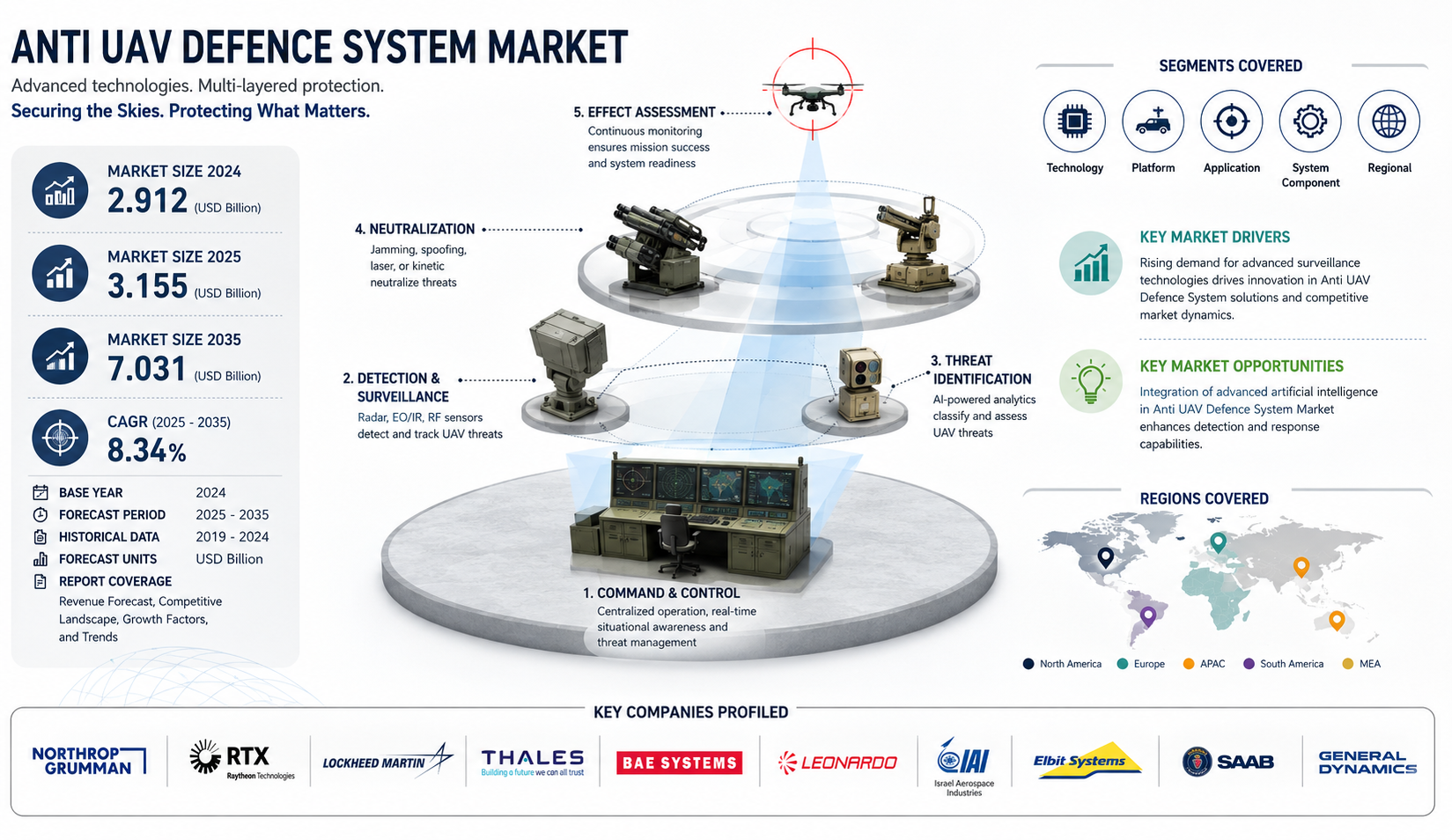
Anti UAV Defence System Market
The Anti UAV Defence System Market is projected to reach USD 7.031 billion by 2035, driven by AI-enabled detection, layered defense and rising drone threats.
Layered defenses provide the most comprehensive defense.”
NEW YORK, NY, UNITED STATES, August 31, 2026 /EINPresswire.com/ -- — Congressional Budget Office
The Anti UAV Defence System Market is entering a period of sustained development as unmanned aerial vehicles become increasingly accessible, autonomous and adaptable. The market was valued at USD 2.912 billion in 2024 and is projected to reach USD 3.155 billion in 2025, before expanding to USD 7.031 billion by 2035, representing a CAGR of 8.34% from 2025 to 2035. The growth trajectory reflects increasing requirements for technologies capable of detecting, identifying, tracking and mitigating unauthorized or hostile unmanned aerial systems.
The competitive landscape includes major defense and aerospace companies such as Northrop Grumman, Raytheon Technologies, Lockheed Martin, Thales Group, BAE Systems, Leonardo, Israel Aerospace Industries, Elbit Systems, Saab, and General Dynamics. Competition is increasingly centered on integrated architectures rather than individual counter-drone components. Companies are developing combinations of radar, radio-frequency sensing, electro-optical and infrared systems, electronic warfare, command-and-control software, kinetic interceptors and directed-energy technologies. Northrop Grumman, for example, has emphasized layered C-UAS architectures combining sensing, tracking, command and control, and kinetic and non-kinetic effects, while Raytheon's Coyote family combines sensing with kinetic and non-kinetic defeat options.
Free Sample Copy - Access A Complimentary Copy of Our Report to Explore Its Content and Insights
https://www.marketresearchfuture.com/sample_request/35602
Market Growth Drivers and Dynamics
One of the principal factors supporting market expansion is the proliferation of small drones and increasingly sophisticated unmanned systems. Their relatively low acquisition cost, commercial availability and ability to operate at low altitudes can create detection challenges for conventional air-defense architectures. Consequently, governments and defense organizations are evaluating layered counter-UAV systems that combine multiple detection and mitigation methods.
The increasing application of artificial intelligence (AI) represents another important market opportunity. AI can support automated object classification, anomaly detection, sensor fusion, threat prioritization and decision support. Instead of relying exclusively on a single sensor or human interpretation, AI-enabled systems can process information from multiple sources and help distinguish drones from birds, aircraft and other objects. Northrop Grumman's AiON, for instance, uses AI-powered decision aids and an open architecture intended to integrate sensors, effectors and third-party technologies.
Technology Segment
The technology segment encompasses the principal methods used to detect, track and neutralize UAVs. Electronics warfare remains important because many drones depend on radio-frequency communications, navigation signals or data links. RF detection can identify transmissions, while jamming can interfere with communications or navigation under appropriate operational and regulatory conditions.
Radar technology is another fundamental component, particularly for continuous airspace monitoring and target tracking. Modern counter-UAV radar systems are being designed to identify small, low-altitude objects and provide tracking information to command-and-control networks. Electro-optical and infrared technologies complement radar by providing visual and thermal identification, particularly when confirmation of a target is required.
The market is also moving toward directed-energy systems, including high-energy lasers, and kinetic interceptors. These technologies provide alternative defeat mechanisms when electronic countermeasures are ineffective or unsuitable. Raytheon's C-UAS portfolio illustrates this layered approach through the combination of KuRFS sensing, Coyote kinetic and non-kinetic effectors, and high-energy laser capabilities.
Platform Segment
By platform, Anti UAV Defence Systems can be deployed across land, airborne and naval environments. Land-based systems represent an important area because military bases, command centers, border installations, airports and critical infrastructure require persistent perimeter protection.
Airborne platforms can provide greater flexibility and wider surveillance coverage, particularly where threats originate beyond the immediate protected area. They may also support mobile military formations. Naval platforms are increasingly relevant as unmanned systems can pose surveillance and attack risks to ships, ports and offshore installations.
Platform requirements vary significantly. Fixed installations can accommodate larger sensors and power-intensive effectors, while mobile systems prioritize compactness, rapid deployment and integration with tactical vehicles. This creates demand for modular architectures capable of operating across multiple deployment environments.
Application Segment
The application segment includes military and defense, homeland security, critical infrastructure, airports, public venues and other security-sensitive environments. Military applications remain central because drones can be used for reconnaissance, targeting, communications support and attack missions.
Homeland security applications are also expanding as unauthorized UAV activity can affect airports, government facilities, borders and major public events. Critical infrastructure—including energy facilities, industrial sites and communications installations—requires protection against surveillance and potential disruption.
The broader application base is encouraging developers to create systems that can be adapted to different operating environments rather than being designed exclusively for battlefield use. Recent developments indicate growing attention toward civilian and commercial counter-UAS applications, although legal authority to detect, disrupt or physically defeat drones varies substantially by jurisdiction.
System Component Segment
The system component segment generally includes detection systems, tracking and identification systems, command-and-control systems, and mitigation or defeat systems.
Detection forms the first stage of the counter-UAV chain and can involve radar, RF sensors, acoustic sensors and electro-optical systems. Tracking establishes the movement and trajectory of a detected object, while identification determines whether it represents a legitimate or potentially hostile UAV.
Command-and-control is increasingly becoming the central integration layer. Modern C-UAS architectures need to combine information from several sensors and select an appropriate response. Northrop Grumman's FAAD system, for example, integrates C-UAS operations with short-range air defense and other missions, demonstrating the importance of common command-and-control architectures.
Mitigation components range from electronic disruption to kinetic interceptors and directed-energy weapons. The growing emphasis on layered defense reflects the limitations of relying on one countermeasure against drones with different sizes, operating profiles and levels of autonomy.
Regional Analysis
North America is expected to remain a major market because of defense modernization programs, investment in counter-small-UAS technologies and growing attention to protecting military installations and critical infrastructure. The United States is also developing increasingly integrated approaches to counter-UAV operations.
Europe is experiencing stronger demand as NATO members seek interoperable counter-drone technologies. In May 2026, NATO's Technical Interoperability Exercise 26 brought together approximately 300 participants, 40 companies from 11 Allied nations and more than 60 commercial systems to assess counter-drone technologies and command-and-control applications.
Asia-Pacific represents an important growth region because of military modernization, border-security requirements and increasing adoption of unmanned technologies. Countries are evaluating radar, electronic warfare and interceptor-based solutions to address both conventional and asymmetric threats.
In South America, demand is comparatively focused on border surveillance, critical infrastructure protection and security applications. The Middle East and Africa (MEA) are increasingly relevant due to regional security requirements, protection of strategic infrastructure and operational experience with unmanned aerial threats.
Key Market Opportunities
The integration of advanced artificial intelligence presents one of the most significant opportunities. AI-based systems can reduce operator workload, improve target classification and support faster response decisions. The development of open architectures may also enable defense organizations to incorporate new sensors and effectors without replacing complete systems.
Another opportunity is the development of cost-effective countermeasures. Since inexpensive drones can potentially impose disproportionate costs on traditional defensive systems, manufacturers are investigating lower-cost interceptors, reusable effectors, electronic warfare and directed-energy technologies.
Industry Developments
1. Raytheon demonstrates non-kinetic Coyote capability against drone swarms: In February 2026, Raytheon announced that its Coyote Block 3 Non-Kinetic system demonstrated launch, flight, interception and recovery capabilities during a U.S. Army demonstration involving drone swarms. The recoverable architecture highlights the industry's interest in reusable counter-UAS effectors alongside traditional expendable interceptors.
2. NATO expands multinational counter-drone technology testing: NATO's May 2026 Technical Interoperability Exercise 26 evaluated more than 60 systems and 40 command-and-control software applications. The exercise reflects the growing emphasis on interoperability, integration and operational testing rather than isolated counter-UAV technologies.
Competitive Landscape and Key Players
Competition in the Anti UAV Defence System Market is shaped by technological breadth, integration capabilities, sensor performance, command-and-control software and the ability to deliver layered defenses. Northrop Grumman is developing AI-enabled C-UAS command-and-control capabilities, while Raytheon Technologies focuses on integrated sensing and kinetic and non-kinetic effectors. Lockheed Martin has demonstrated a scalable C-UAS architecture combining AI-enabled detection and tracking with multiple sensors and effectors.
Other prominent companies include Thales Group, BAE Systems, Leonardo, Israel Aerospace Industries, Elbit Systems, Saab and General Dynamics. Their competitive strategies span radar, electronic warfare, command-and-control, surveillance, interceptors and integrated air-defense solutions. As UAV threats become more diverse, competitive differentiation is increasingly likely to depend on how effectively individual technologies can operate as part of a broader networked defense architecture.
Future Outlook
From 2025 to 2035, the Anti UAV Defence System Market is expected to transition further from standalone counter-drone equipment toward networked, AI-assisted and layered defense ecosystems. The market's projected increase from USD 3.155 billion in 2025 to USD 7.031 billion in 2035 reflects sustained demand for systems capable of responding to evolving UAV technologies.
Future development is likely to focus on faster detection, automated classification, multi-sensor fusion, improved swarm response, lower-cost interceptors and greater interoperability. At the same time, system developers will need to address spectrum management, false alarms, cybersecurity, operating costs and regulatory requirements. The ability to combine multiple technologies into a coordinated defense architecture will remain a central factor shaping the market through the forecast period.
Frequently Asked Questions
1. What is driving the Anti UAV Defence System Market?
The major drivers include the proliferation of drones, increasing security requirements, demand for advanced surveillance technologies, development of layered air defense and the integration of artificial intelligence into detection, tracking and response systems.
2. What is the projected size of the Anti UAV Defence System Market by 2035?
The market is projected to reach USD 7.031 billion by 2035, growing from USD 3.155 billion in 2025 at a CAGR of 8.34% during 2025–2035.
Read Our Related Research Report
UAV LiDAR Market -
https://www.marketresearchfuture.com/reports/uav-lidar-market-6256
Fixed Wing VTOL UAV Market -
https://www.marketresearchfuture.com/reports/fixed-wing-vtol-uav-market-27227
UAV Sense and Avoid System Market -
https://www.marketresearchfuture.com/reports/uav-sense-avoid-system-market-40345
Military UAV Sensor Market -
https://www.marketresearchfuture.com/reports/military-uav-sensor-market-6095
Vertical Take-off and Landing (VTOL) UAV Market -
https://www.marketresearchfuture.com/reports/vtol-uav-market-6279
Sagar Kadam
Market Research Future
+1 628-258-0071
email us here
Legal Disclaimer:
EIN Presswire provides this news content "as is" without warranty of any kind. We do not accept any responsibility or liability for the accuracy, content, images, videos, licenses, completeness, legality, or reliability of the information contained in this article. If you have any complaints or copyright issues related to this article, kindly contact the author above.
